Why Mobile Players Convert When They Do (and What to Offer Each One)
 Mario F. Machado·2026-05-27
The window a player converts in reveals the motivation behind the purchase. Players who buy early, mid-game, and late are each responding to a different trigger, and offers designed for one mostly miss the others. Here is how to design for all three.
Most studios look at aggregate conversion and build one offer to fix it. When the number is low, they cut the price. When that doesn't work, they cut it again.
The price isn't the problem. The offer is designed for one player motivation and deployed against all of them.
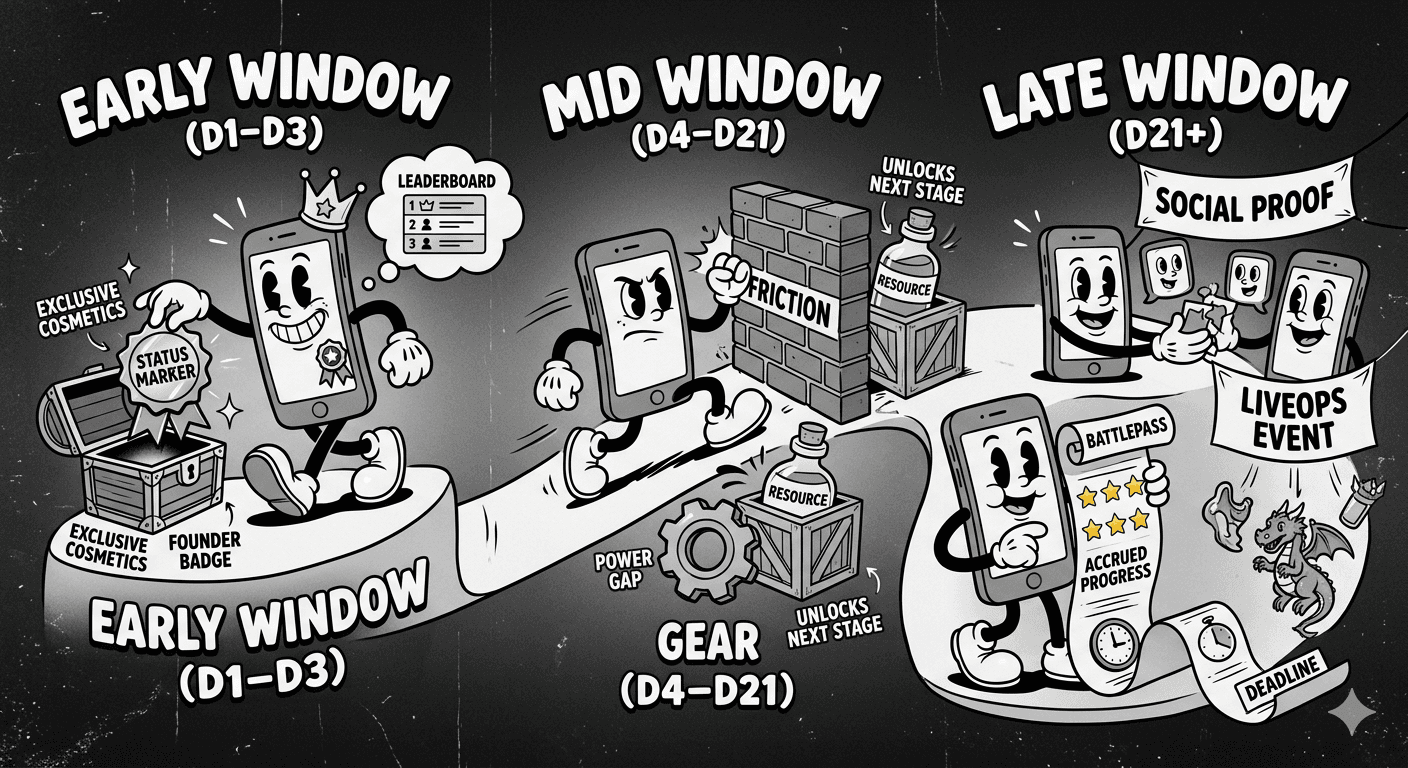
Conversion timing isn't random. It clusters around three behavioral windows, each driven by a different motivation. A player who buys on Day 1 is doing something different from one who buys on Day 15 or Day 35. The motivation behind the purchase shifts with time in the game, and an offer designed for one motivation mostly misses players who are there for something else. The three-window structure here is an analytical frame, not a published taxonomy. Your own telemetry, genre, and player base will tell you whether these windows behave distinctly in your title.
If you're still working out whether your conversion rate is healthy or how to calculate it correctly, read this first: How to Calculate First-Purchase Conversion Rate in a Mobile Game. This article picks up where that one ends.
The early window (D1–D3)
AppsFlyer gaming report data shows roughly a quarter of eventual payers convert by Day 2, with another 17% by Day 3.[1] This is the single largest conversion window by volume.
The early window has two distinct player types with completely different needs. Treating them the same is the fastest way to leave early conversion on the table.
The Status Seeker
Research on competitive spirit and in-game impulse purchasing found that need for popularity fully mediates the relationship between competitive attitudes and purchase behavior. Social competence moderates this negatively: players with lower social competence are more strongly driven to impulse-purchase when motivated by the need for popularity.[2] A separate study developed an in-game purchase motivation scale across two samples of gamers (573 and 284), arriving at a five-factor model that includes a reputation (social status in the gaming community) dimension as one of the five.[3] Both studies skew toward community-embedded gamers, so the effect size is likely strongest in titles with visible social infrastructure: leaderboards, guilds, public rankings.
One caveat worth taking seriously: escape motivation (using the game to decompress) outranks competitive motivation as a spend predictor across broader player populations.[4] The Status Seeker is a real Day 1 cluster, but not the dominant payer archetype. Studios that build their whole offer strategy around competition miss a larger share of eventual payers who don't think of themselves as competitive. There's also a distinction within competition itself: players motivated by removing friction so they can keep playing at their level look more like Milestone Converters than Status Seekers, and they respond to different offers regardless of what day they buy.
The Pre-Primed Converter
No public study has measured what share of Day 1 converters arrive pre-primed versus getting converted by in-game mechanics. The Pre-Primed Converter is a real behavioral cluster, but its size relative to other Day 1 buyers isn't established in the public record.
The mid window (D4–D21)
Players who didn't buy in the early wave kept playing. The game earned something from them. What eventually triggers the purchase isn't a status signal or pre-formed intent. It's something that happens inside the game, usually when progress and cost arrive at the same moment.
The Milestone Converter
GameRefinery and Liftoff identify milestone triggers as the primary mid-funnel conversion mechanism for players who didn't buy on Day 1: an IAP offer right after a player completes a significant level or hits a meaningful friction point.[5]
The Value-Triggered Converter
Price anchoring research shows that the first price a buyer sees shapes what feels reasonable in the decisions that immediately follow it. The anchor is arbitrary, but it frames the reference point a buyer uses to evaluate the next offer.[6]
Mistplay's survey of 2,000 IAP spenders found 33% convert when they see "a deal too good to pass up."[7] These players aren't blocked. They're waiting for an offer that clears a personal value threshold. Perceived value, pricing, framing, and timing all compound here. No single lever explains why it finally lands.
A note on Day 7
Studios ask about Day 7 a lot. No public research isolates it as a distinct behavioral inflection point. Habit formation research (from health behavior contexts, applied directionally to gaming) finds automaticity takes considerably longer than a single week to develop.[8] Day 7 players are still deciding.
The trigger to watch is when players first hit your game's primary progression gate. That day varies by title. A universal D7 assumption is a substitute for that data, not the same thing.
The late window (D21+)
After 21 days without purchasing, a player isn't unconverted. They're just unresolved: still active, still engaged, still deciding.
Industry data shows 77% of eventual payers convert within their first two weeks, and over 80% by Day 21.[9] The players still unspent after three weeks are a smaller share, but they've been playing long enough that something specific has to resolve the deliberation.
The Battlepass Commitment Converter
Two academic effects are at work here. The endowed progress effect (Nunes and Dreze, 2006) was established in consumer loyalty card research: participants given an artificial head-start toward a goal completed it at significantly higher rates than those who started from zero, because accrued progress creates psychological commitment to follow through.[10] The goal-gradient effect (Kivetz, Urminsky, and Zheng, 2006), from consumer rewards program research, shows people accelerate purchasing non-linearly as they approach a reward threshold.[11] Both were studied outside gaming. Nobody has run either experiment in a battle pass setting. The structural parallel is plausible, but it's reasoning by analogy.
The LiveOps Event Trigger
The mechanism is well-supported: contextual in-game offers triggered by player behavior convert at higher rates than untargeted promotions.[12] On magnitude: precise lift figures are thin in the public record. The available numbers come from practitioner sources, which means treat them as directional.
The Social Proof Converter
The mechanism is behavioral: when a player watches peers spend and visibly receive value, the purchase stops feeling like a trap and starts feeling like a decision others have already made. No public study verified for this post directly measures the effect in a mobile game context. The persona is grounded in social comparison theory, but the IAP-specific magnitude is something your own data would need to establish.
The persona the windows miss
Each of the eight window-based personas above converts at a recognizable moment: a status signal, a pre-formed intent arriving at session one, a progression wall, a compelling offer clearing a threshold, a battle pass deadline, a live event, or a social tipping point. The timing tells you something about the motivation.
One persona doesn't work this way.
The Escape Converter
Research across large F2P samples consistently finds escape motivation outranks competitive motivation as a spend predictor across the full payer population.[4] These players are largely invisible to studios whose offer strategy is built around competitive or achievement triggers. Not because they won't spend, but because the offers never address why they're playing.
The window-based personas describe when players convert. This one is about why a large share of eventual payers get missed at every stage.
What to do with this
These personas aren't personality types to identify upfront. They're behavioral clusters that emerge from what window a player converts in and what triggered it. Most studios don't know which cluster their conversion concentrates in because they haven't looked at their data that way.
What moves a player from deliberation to purchase is never just price. It's usually several things compounding at once (timing, perceived value, framing, social context), which is why the same offer fails some players and converts others. The personas here are a starting point for sorting out which variables matter most for which player.
Where to look next depends on where your conversion concentrates. That's a data question, and it has a different answer for every title.
◆ References
- 1.AppsFlyer State of Gaming App Marketing 2024
- 2.Cengiz, Pouyan & Azdemir — Computers in Human Behavior 2025 Competitive spirit and in-game impulse purchase: need for popularity as mediator
- 3.Duradoni et al. — IJCGT 2025 (N=857) Five-factor in-game purchase motivation scale
- 4.Costes & Bonnaire — PMC 2022 (N=5,062) Escape motivation and competitive motivation as predictors of spend
- 5.GameRefinery / Liftoff 2024 Milestone triggers and engagement offers for mid-funnel conversion
- 6.Ariely, Dan — Predictably Irrational (2008) Anchor prices shape all subsequent price judgments: arbitrary coherence and the anchoring effect on willingness to pay
- 7.Mistplay — Mobile Gaming Spender Report 2024 (N=2,000) Deal-triggered conversion motivation
- 8.Lally et al. — European Journal of Social Psychology 2010 How are habits formed: modelling habit formation in the real world
- 9.Unity / ironSource — Mobile Growth and Monetization Report 2023 77% of IAP payers convert within first two weeks; over 80% by Day 21
- 10.Nunes & Dreze — Journal of Consumer Research 2006 The endowed progress effect: how artificial advancement increases effort
- 11.Kivetz, Urminsky & Zheng — Journal of Marketing Research 2006 The goal-gradient hypothesis resurrected: purchase acceleration and customer retention
- 12.AppSamurai LiveOps Playbook 2026 Contextual IAP offers vs. untargeted promotions

Mario F. Machado
Founder, LootRate
Founder of LootRate. Previously Lead Product Designer at WB Games, where he built the D2C revenue infrastructure for six live mobile titles. LootRate audits mobile game monetization across 14 dimensions and identifies the highest-leverage experiments studios aren’t running.
Where does your game score on First-Purchase Conversion?
Friction and incentive design on the critical first payer conversion event. A 30-minute intro call is a straight conversation about your game's revenue and whether bringing in an owner makes sense.
▸Talk through your revenue30 minutes. A straight conversation about your revenue.
◆ The intro call
- A conversation about your game's revenue and goals
- Where the upside likely is, and what owning it looks like
- Whether we're the right fit to take it on